

からくり人形の画像にチャレンジします。実物と同じようには生成できないでしょうけれども、ある程度違和感のない画像を目指したいです。
作成の流れ
・My Gemを使ってプロンプトづくりをする
・作成されたプロンプトを使ってChatGPT+画像生成で生成する
・My Gemに戻りプロンプトを修正する
・修正されたプロンプトを使ってChatGPT+画像生成で生成する
・最終的に完成したプロンプトを使いNano Banana 2で画像生成する
始まりの画像
A photorealistic, highly detailed photograph of a traditional Japanese Edo-period mechanical automation doll, a “Karakuri Ningyo Yumihiki Doji” (Bow-Pulling Boy). The doll, appearing as a young Japanese boy, is meticulously dressed in authentic, richly textured silk Edo-period robes (kimono and hakama) with traditional patterns. He is in the dynamic action of nocking an arrow to his miniature bow string. A crucial, intricate detail is that a portion of his body and clothing is rendered as a cutaway or transparent, revealing the complex, internal clockwork mechanism beneath: miniature gears, springs, levers, and brass and iron components that power his movement. He is focused on his task. The only other object present is a simple, traditional Japanese wooden target (mato) with a bullseye, positioned to receive the shot. The entire scene is set against a clean, completely neutral, featureless background (e.g., solid studio grey or pure white, implying no context but the subjects themselves, or prepared for a transparent alpha channel). The lighting is precise, directional, and clean, like studio product lighting, to highlight every fine detail: the wood grain of the doll’s face and hands, the weave of the silk fabric, the polished and worn textures of the internal metal mechanisms, the target, and the small arrow. Shot on a Canon EOS R5 with a 50mm lens. The depth of field is shallow, rendering the doll and target in sharp focus while completely isolating them from the void of the background. 8k resolution, macro-photography detail level, museum artifact quality.

からくり人形の主なからくり部分は、下部にある箱の中なのでそのように修正します。的は不釣り合いなので生成しないようにします。
A photorealistic, highly detailed photograph of a traditional Japanese Edo-period mechanical automation doll, a “Karakuri Ningyo Yumihiki Doji” (Bow-Pulling Boy), positioned on top of an elaborate, decorative wooden box. The doll itself is meticulously dressed in authentic, richly textured silk Edo-period robes (kimono and hakama) with traditional patterns, and is in the dynamic action of nocking an arrow to his miniature bow string. His eyes are fixed on his task. There is no target. The crucial detail is that the doll’s body is fully clothed, but a large section of the decorative wooden box directly beneath his feet is rendered with a transparent, polished glass or acrylic panel, revealing an incredibly dense, intricate clockwork mechanism within the box: miniature gears, interlocking brass cogs, steel mainsprings, levers, pulleys, and winding mechanisms. Connecting rods subtly extend from the doll’s feet down into the box’s mechanism, showing the transmission of power. The wooden box itself has traditional carvings and polished surfaces. The entire scene is set against a clean, completely neutral, featureless background (pure white studio void), providing no context but the subjects themselves. The lighting is precise, directional, and clean, like studio product lighting, to highlight every fine detail: the wood grain of the doll’s face, the texture of the silk fabric, and the complex, interlocking metal components within the transparent box section. Shot on a Canon EOS R5 with a 50mm lens. The depth of field is shallow, rendering the doll and the detailed box in sharp focus while completely isolating them from the background void. 8k resolution, macro-photography detail level, museum artifact quality.

矢の向きが反対なので修正します。
A photorealistic, highly detailed, museum-quality photograph of a traditional Japanese Edo-period mechanical automaton doll, a “Karakuri Ningyo Yumihiki Doji” (Bow-Pulling Boy), positioned on top of an elaborate, decorative wooden display base. The boy doll is meticulously dressed in authentic, richly textured silk Edo-period robes (kimono and hakama) with traditional patterns, and features a traditional Japanese 丁髷 (topknot) hairstyle. The doll is in the focused act of nocking an arrow to his miniature bow string, holding the bow in his left hand, and his right hand holds the fletched end (nock and feathers) of the arrow and the string with his thumb and index finger. CRITICAL DETAIL: The arrow’s fletched end (with feathers) is properly seated on the nocked bowstring, held by the boy’s right fingers. The sharp metal arrowhead is pointing forward, extending past the bow. The doll stands centered on the display case. The large wooden box (display case) beneath the doll, adorned with traditional carvings, has a substantial section directly beneath the doll made of clear, polished glass, revealing an incredibly dense, intricate clockwork mechanism within the box: miniature brass gears, interlocking cogs, steel mainsprings, levers, pulleys, and winding mechanisms. Connecting rods subtly extend from the doll’s feet down into the box, connecting the doll to the mechanism. The entire scene is set against a clean, completely neutral, featureless background void (pure white studio grey). There is no target generated. The lighting is precise, clean, directional studio product lighting, highlighting the textures of silk, wood grain of the doll’s face and hands, 丁髷 hair, and the complex, interlocking metal components within the transparent box section. Shot on a Canon EOS R5 with a 50mm lens. The depth of field is shallow, rendering the full doll and the detailed base in sharp focus, while completely isolating them from the background void. 8k resolution, macro-photography detail level.
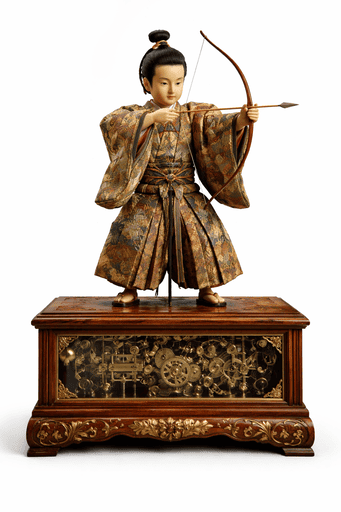
できました。「丁髷 (topknot) hairstyle.」というプロンプトが面白いですね。
Nano Banana 2

ChatGPTよりとてもリアリティーのある画像になったと思います。人形もからくり部分もいいですね。ちょんまげヘアーも完璧です。

コメント